Table of Content
- Introduction
- Image
- Technology Breakdown
- Strategic Analysis
- Real War Examples
- Future Warfare Impact
- Conclusion
- FAQ
How Drone Swarm Warfare Works: Introduction
In the early months of 2026, a single Ukrainian operator positioned behind a frontline trench successfully directed a coordinated mesh of 25 fiber-optic FPV drones that simultaneously overwhelmed a Russian artillery battery located 18 kilometers deep in enemy territory. The drones shared targeting data in real time, dynamically adapted to active electronic jamming attempts, and executed strikes from multiple vectors while the operator monitored the entire operation through a single ruggedized tablet. This was not a simulated exercise or a futuristic concept — this was drone swarm warfare operating at full scale in a live combat environment.
How drone swarm warfare works represents one of the most significant tactical revolutions in modern military history. At its core, the concept involves dozens, hundreds, or even thousands of low-cost military drones operating as a single intelligent organism. These drones are connected through advanced AI mesh networks, decentralized decision-making algorithms, and edge computing capabilities that allow them to function with minimal or no central human control after initial launch. The result is a highly resilient, self-organizing system capable of saturating defenses, conducting reconnaissance, and delivering precision strikes far more effectively than traditional single-platform operations.
The rapid evolution of this capability became evident between 2025 and 2026. Ukraine dramatically scaled coordinated multi-drone operations, conducting more than 100 documented swarm-involved missions across multiple sectors. Russia responded by deploying mothership repeater drones to extend the range of FPV units. China publicly demonstrated one soldier controlling up to 200 AI-enabled drones in synchronized formations during large-scale exercises. Meanwhile, the United States accelerated its Replicator program, focusing on orchestration systems that integrate swarms across air, land, and sea domains.
This article provides a comprehensive, expert-level explanation of how drone swarm warfare works, breaking down the technical mechanics, tactical advantages, emerging counter-drone defense systems, leadership dynamics among major powers, and the long-term implications for future warfare from 2025 to 2035. Drawing from the latest operational data, doctrinal shifts, and technical specifications released in the past 12 months, it offers defense professionals, military planners, and strategic analysts the authoritative insights needed to understand and prepare for this new era of conflict. For a broader overview of autonomous coordination technologies, readers can explore our detailed UAV Swarms analysis.
Technology Breakdown
How Drone Swarm Warfare Actually Works – Step by Step
Drone swarm warfare operates through four tightly integrated technological layers that enable seamless coordination and execution:
- Launch and Initial Coordination Layer Mothership drones (such as Ukrainian heavy multicopters or Russian Orlan/Molniya variants) serve as mobile launch platforms. These larger platforms release dozens of smaller FPV or loitering munitions. Upon release, an AI mesh network instantly forms, connecting every drone without requiring a single central command node. This decentralized architecture is what makes the swarm resilient — if one or several units are lost, the remaining drones automatically reconfigure.
- Decision-Making and Adaptation Layer Reinforcement learning algorithms combined with edge computing allow individual drones to self-assign targets, avoid collisions, and adapt to electronic warfare threats in real time. In 2026 Ukrainian systems, fiber-optic links provide jam-resistant control for the critical final 10–15 kilometers of flight, while AI optical recognition identifies high-value targets even when GPS is denied. China’s PLA has advanced this further with bio-inspired swarm formations that mimic bird flocks for enhanced evasion.
- Execution and Saturation Layer Once in the target area, the swarm divides roles dynamically: some drones act as decoys to draw fire, others provide continuous ISR (Intelligence, Surveillance, Reconnaissance) feeds, and the remainder deliver kamikaze or loitering munitions strikes. One operator can now oversee 10–25 drones simultaneously, dramatically reducing manpower requirements compared to traditional operations.
- Feedback and Re-tasking Loop Real-time data sharing across the mesh updates the entire swarm continuously. If a primary target is destroyed, secondary targets are automatically prioritized. This closed-loop system allows mid-mission adjustments that were previously impossible with conventional munitions.
These capabilities are powered by advancements in compact AI processors, low-cost sensors, and high-bandwidth mesh protocols. Technology Readiness Levels for full swarm coordination reached 7–9 in active combat zones by mid-2026, a remarkable leap from experimental stages just two years earlier.
Counter-Drone Defense Systems – How They Attempt to Counter Swarms
Modern counter-drone defense systems have evolved into sophisticated multi-layered architectures designed specifically to neutralize swarm threats:
- Detection Phase: Integration of radar, optical cameras, RF sensors, and acoustic detection creates a comprehensive threat picture.
- Disruption Phase: High-power microwave (HPM) weapons, directed-energy lasers (such as the US AMP-HEL system), and advanced RF jamming attempt to break the mesh network.
- Kinetic Interception Phase: Physical countermeasures including nets (Fortem DroneHunter), shotgun-style rounds, and dedicated interceptor drones engage surviving units.
- AI Predictive Layer: Machine learning algorithms analyze swarm behavior patterns to prioritize the highest-threat drones before they reach critical range.
Germany’s DroneHammer system, unveiled at Enforce Tac 2026, and Belgium’s FN Herstal multi-layer platform represent the current state-of-the-art, achieving 80–90% interception rates against small formations. However, real-world testing against coordinated 100+ drone swarms has shown significantly reduced effectiveness, highlighting the growing gap between defensive technology and offensive swarm capabilities.
For additional technical depth on autonomous decision-making in these systems, refer to our Autonomous Battlefields resource.
Strategic Analysis
Tactical Advantages of Drone Swarm Warfare
The tactical advantages of drone swarm warfare are profound and multifaceted:
- Cost-Effective Saturation: A single swarm costing under $50,000 can overwhelm air defense systems valued in the millions, fundamentally altering the economics of warfare.
- Resilience and Redundancy: Decentralized AI ensures that losing 40–60% of units does not necessarily fail the mission — remaining drones continue to adapt and execute.
- Force Multiplication: One operator supported by a mothership can achieve effects previously requiring an entire platoon or even air support squadron.
These advantages have driven a doctrinal shift from reliance on exquisite, high-value platforms to mass attritable systems. Traditional air defense doctrines focused on intercepting individual high-threat targets; swarm warfare forces defenders to address volume and coordination simultaneously. This change is forcing military planners worldwide to rethink resource allocation, training, and procurement strategies.
Who Leads vs. Lagging in 2026 – Comprehensive Comparison
| Nation | Swarm Capability (2026) | Key Strength | Counter-Drone Investment Focus | Overall Ranking |
|---|---|---|---|---|
| China | 200-drone control per operator; bio-inspired AI | Massive scale and rapid production | Urban and Taiwan-specific layered systems | Leading in scale |
| Ukraine | 8–25 coordinated drones per mission (100+ ops) | Combat-proven fiber-optic tactics | Rapid domestic counter-innovation | Leading in tactics |
| Russia | Mothership repeaters + AI multi-FPV control | High-volume daily production | Heavy emphasis on electronic warfare | Strong in volume |
| USA | Replicator orchestration systems | Advanced funding and multi-domain integration | Replicator 2 counter-UAS acceleration | Leading in potential |
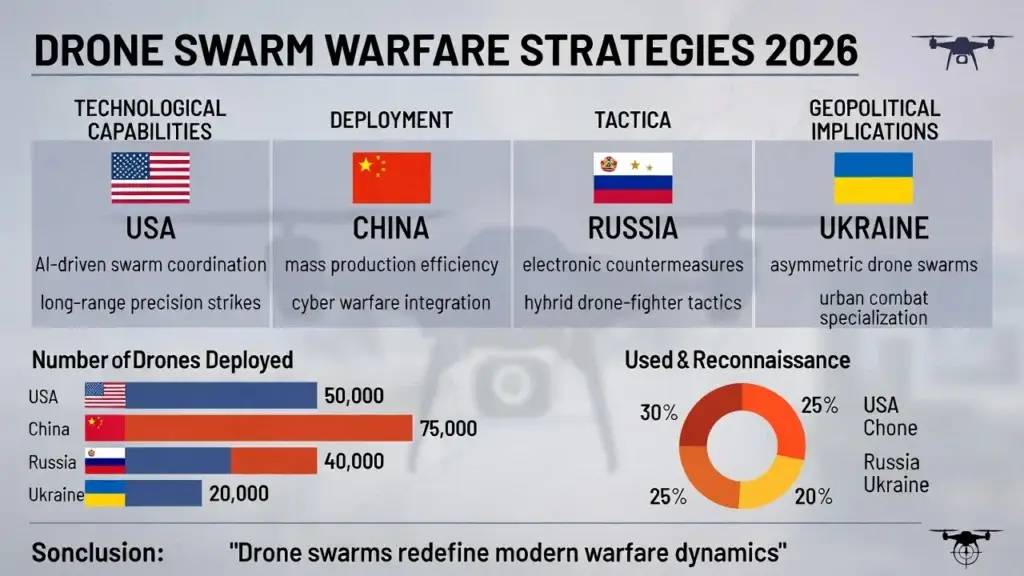
China currently leads in raw AI scale and production capacity. Ukraine leads in real-world tactical innovation and proven effectiveness. Russia maintains strength in sheer volume but faces sanctions-related limitations. The United States possesses superior funding and integration potential but continues to lag in rapid field deployment compared to peer competitors.
For deeper comparative modeling, the RAND Corporation report on autonomous swarm operations provides valuable quantitative analysis.
Risks, Limitations, and Countermeasures
Despite its advantages, drone swarm warfare faces several limitations: limited battery endurance (typically 15–40 minutes), vulnerability to extreme weather, and susceptibility to sophisticated multi-frequency jamming. Countermeasures continue to evolve rapidly, with directed-energy weapons and AI-driven predictive interceptors closing the gap. However, the cost asymmetry remains a major challenge — defensive systems are often significantly more expensive than the attacking drones.
Ethical considerations are equally critical. Reduced human oversight in lethal decision loops raises questions about accountability and escalation risks, particularly in urban or densely populated areas. International efforts to establish norms for autonomous lethal systems remain ongoing but lag behind technological deployment.
Real War Examples
Ukraine 2025–2026: The Most Advanced Real-World Swarm Operations
Ukrainian forces executed over 100 swarm-involved missions throughout 2025 and early 2026. Typical operations involved groups of 8–25 drones coordinated via motherships and fiber-optic links. Russian forces countered with mothership Orlan and Molniya drones that extended FPV operational range to 25 kilometers. Ukrainian innovators also pioneered “drone-versus-drone” interceptor tactics, creating the first documented examples of swarms defending against other swarms.
These operations demonstrated how drone swarm warfare works under real contested conditions, achieving strategic effects that previously required expensive manned aircraft or precision-guided missiles. Detailed operational data and lessons learned are extensively covered in the International Institute for Strategic Studies (IISS) Strategic Dossier on Drone Warfare in Ukraine 2026.
Additional examples from the same conflict include the successful use of swarms to suppress Russian air defenses during major advances in the Donetsk and Kharkiv sectors, proving the system’s effectiveness against peer-level electronic warfare.
Future Warfare Impact
2025–2035 Outlook and One Future Warfare Prediction
By 2030, fully autonomous swarms are projected to integrate seamlessly with hypersonic missiles, cyber operations, and space-based assets. Global military spending on military drones and counter-drone systems is expected to exceed $33 billion annually by 2035 according to SIPRI projections.
Future warfare prediction: In a potential Taiwan contingency scenario, Chinese “smart swarms” could establish an 80-kilometer asymmetric hellscape consisting of layered air, sea, and ground attackers. This would force defending forces — including US and allied assets — to depend heavily on directed-energy counter-drone systems or accept unsustainable attrition rates. The integration of quantum-enhanced AI for swarm coordination could further accelerate decision cycles to seconds, fundamentally altering command-and-control structures.
Comparison: Swarm Advantages vs. Counter-Drone Effectiveness
While swarm saturation continues to defeat single-layer defenses, only advanced multi-layered AI counter-drone systems (combining electronic warfare, directed energy, kinetic interception, and predictive analytics) can restore defensive balance. However, these systems require substantial investment and rapid technological adaptation to remain effective against evolving swarm tactics.
For additional projections on multi-domain integration, see our Naval Defense and Air Supremacy sections.
Conclusion
Drone swarm warfare now works through sophisticated AI mesh coordination, decentralized decision-making, and low-cost saturation tactics that have permanently transformed the character of modern conflict. The tactical advantages — cost efficiency, resilience, and force multiplication — have already been proven on the battlefields of Ukraine and are being rapidly scaled by major powers including China, Russia, and the United States.
Counter-drone defense systems must evolve at an equal or greater pace, or military forces risk decisive defeat in future engagements. The era of swarm dominance has arrived, and understanding exactly how drone swarm warfare works is no longer optional for any serious defense organization.
FuturWave.com continues to serve as the leading global platform for authoritative, forward-looking defense analysis. Defense leaders, military planners, and strategic thinkers seeking deeper technical reports, customized swarm integration briefings, or access to our exclusive research library are invited to engage directly with our team. The future of warfare is already here — and it flies in swarms.
How exactly does drone swarm warfare work in 2026?
Drone swarm warfare uses AI mesh networking and reinforcement learning so individual military drones act as one coordinated unit — sharing targets, adapting to jamming, and saturating defenses without constant human input.
What are the main tactical advantages of drone swarms?
Saturation of expensive defenses, resilience through decentralization, and massive force multiplication at low cost — turning $1,000 drones into strategic-level weapons.
How effective are counter-drone defense systems against swarms?
Layered systems (RF jamming, lasers, nets, AI interceptors) achieve high success against small groups but face growing challenges from 2026 AI-coordinated swarms.
Which country leads in drone swarm warfare in 2026?
China leads in scale (200-drone control per operator); Ukraine leads in combat-proven tactics; Russia in volume; the USA in funding and multi-domain integration.
What future warfare changes will drone swarms bring by 2035?
Autonomous swarms will dominate multi-domain operations, creating “hellscape” scenarios and forcing global investment in advanced counter-drone systems and new doctrines.